
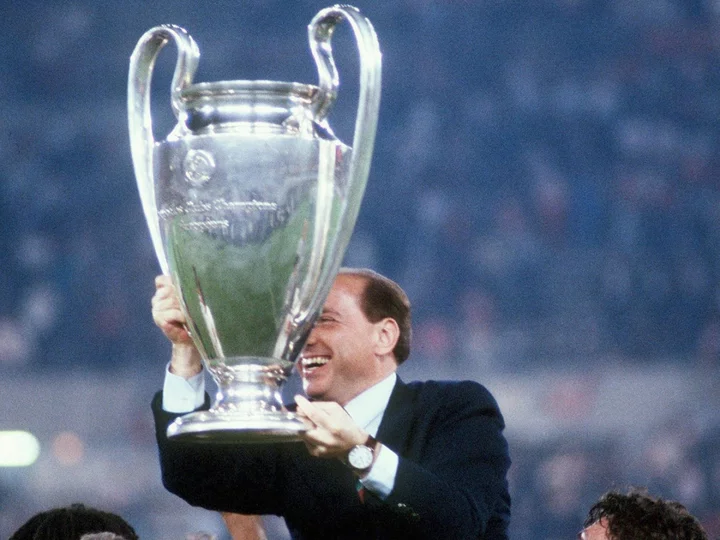
The story of Silvio Berlusconi and the birth of the Champions League
A version of this story was published in February 2017 Diego Maradona was one of many players struck by the strange “uniqueness” of the occasion. He wasn’t to know the half of it. Because, the last and only other time that Napoli travelled to Real Madrid - back in the 1987-88 European Cup - it involved a hugely bad-tempered game that also saw a manager call a player a “mafioso” and took place in front of no fans and in an odd silence, due to crowd trouble the previous season from Real’s infamous Ultrasurs. It was hardly the setting for such a highly anticipated match between two heavyweights, not to mention the meeting of one of the greatest players ever and the most successful European Cup club ever. All of that will likely get replayed in the build-up to Napoli’s return to the Bernabeu on Wednesday, but none of it is what really makes that 1987 match unique. This was actually the game that changed European football. AC Milan owner Silvio Berlusconi was one of many watching, but he couldn’t share in the excitement around the fixture. He was aghast at the fact that two clubs like that could meet as early as the first round of the competition, as was happening here. It was hardly the stage to waste such a highly anticipated clash, or to waste one of the sides that would be eliminated but instead should have been making the competition all the more enticing later on. Berlusconi naturally feared the same could happen to his own club, but also had wider concerns. So, he set in motion his plans for a European super league. That didn’t happen, but the idea - and the threat - directly led to the creation of the Champions League, and the super-club-dominated era we have today. It is also a situation with several levels of irony. What is only the second ever tie between Real and Napoli is now seen as a novelty in a last-16 stage that has meetings of Barcelona-PSG and Arsenal-Bayern Munich both being replayed for the fourth time in just five years, a level of repetition that has dulled some of the Champions League’s intrigue and mystique. It was exactly the intrigue and a mystique of a rarely-played fixture coming in the competition’s old opening knock-out round, however, that led to that. What’s more, this growth of the Champions League has someway cannibalised some of those who were initially so behind super league ideas - from Rangers in Scotland to Liverpool and even Milan themselves. It’s certainly difficult not to wonder what Berlusconi now thinks about Milan’s meek drift away from the glamorous competition he helped create. You don’t have to wonder what Real and Napoli thought on being drawn against each other so early in 1987, though. They were stunned. Part of the reason was that the first-time Italian champions had no European pedigree, so were unseeded. Real’s pedigree was emphasised by the fact this was their 100th European Cup match at the Bernabeu, making it all the more incongruous that it would take place in front of the stadium’s empty stands. A two-game closed-doors order was the price for crowd trouble in the previous season’s semi-final against Bayern Munich. It was probably oddly fitting that the match that would prove so transformative for the quality, glamour and scope of the competition, however, was a poor game played in front of nobody. Described by Mundo Deportivo at the time as a “cold” occasion where the players were “orphaned” on the pitch, it did heat up between the teams. Both squads probably took Maradona’s demand to “go and batter them!” a bit too literally. Many kicks and apparently punches were traded, a bag of ice was thrown at Real manager Leo Beenhakker, and Napoli’s Salvatore Bagni later claimed the Dutch coach and some of his players had called him “mafioso”. Beenhakker did apologise for that before the second leg, again citing the “unique” circumstances of the game, but from the vantage point of a 2-0 victory. The goals summed up the level of performance. Michel scored from a penalty, Fernando De Napoli was responsible for an own goal, all to the sound of silence. Returning to Spain for the first since leaving Barcelona in 1984, Maradona had been marked out of the game, and blamed Napoli’s poor display on the pressure of a first appearance in the competition. “You don’t have to exaggerate,” he said. “We did not see the true Napoli, perhaps because of the responsibility of a debut in the European Cup.” It was exactly this kind of quirk, however, that so concerned Berlusconi. He just couldn’t see the logic in the competition’s best - and most televisually lucrative - teams potentially going out because of one bad night, one stroke of bad luck. It was precisely this Berlusconi feared for Milan, as he admitted in what would prove a hugely prescient interview with World Soccer in 1991. Amid predictions about the decline of international football and how European Union regulations would completely condition the continental game, the mogul came out with the following: “The European Cup has become a historical anachronism. It is economic nonsense that a club such as Milan might be eliminated in the first round. It is not modern thinking.” Berlusconi had shown a lot of very modern thinking, particularly by football’s conservative standards, since taking over Milan in 1986. Though always a fan of the club, he saw them as one arm of his business empire. Berlusconi made little secret of his plans to use both the Rossoneri brand and his media company Mediaset together to maximise both. Having already revolutionised broadcasting in Italy with the way his innovative approach to regional stations evolved into the country’s first national private TV station in Canale 5, he had similar plans for football. Berlusconi felt the sport was utterly wasting its potential in this area, and not at all reaching a potential pay-TV audience of millions and beyond. He thought it absurd that the biggest clubs in a sport that involved so many popular stadium events were not regularly meeting in glamorously lucrative matches. Martin Schoots is now a prominent European agent representing players such as Christian Eriksen, but was then a journalist primarily covering the three Dutch stars at Milan - Marco van Basten, Ruud Gullit and Frank Rijkaard - and was always impressed with Berlusconi’s approach when they met. “He was a visionary,” Schoots says,” and very clear and convinced about what developments would come. His philosophy was that football was a spectacle.” Or, as was put by some of those close to Berlusconi, “the television spectacular world-wide” - and the potential audience for his Canale 5. Making the European Cup a super league was not quite a new idea, though. That had actually been creator Gabriel Hanot’s initial plan for the competition in 1955 in order to better reflect “rightful” champions than the nuances of knock-out football, but proved impractical with the travel and communication of the time. Liverpool had also come up with a discussion document suggesting mini-leagues in 1978, around the time they were drawn against Nottingham Forest in the first round, and that had been revived in 1984. No-one, however, had gone for it with the same force or sense of structure to it as Berlusconi. this Super League was based on merit, tradition and television - and therefore it was a league for big television markets Alex Flynn After initial moves with Real president Ramon Mendoza were rejected, the Italian businessman decided to commission a blueprint for a ‘European Television League’ in 1988. The man who ended up with that commission was Alex Fynn, then of Saatchi and Saatchi. A huge football supporter, Fynn had already given a talk at an event for the Rothman’s Football Yearbook called a ’10-point blueprint for football’, suggesting exactly a European super league. It was subsequently printed in the Times, and word got around. “A few weeks later, I got a call from the head of our Italian agency,” Fynn tells The Independent now. “He said ‘here’s the job you always wanted: design a super league for Berlusconi.’ And the reaction? “My reaction? My reaction was my head was turned, I was flattered, and I did what I thought he wanted - not necessarily what football needed. So this Super League was based on merit, tradition and television - and therefore it was a league for big television markets. I think it had a league of about 18 clubs and certainly two each from England, Italy, Spain… that was the plan.” It was a plan initially rejected by Uefa, but had still done its job. The idea was out there, as was the underlying threat of a possible breakaway and possible changes were now on the table. “He decided to publicise it and use it as a stalking horse and catalyst to support his argument,” Fynn says of Berlusconi. “I think it went further than that. When someone like Berlusconi has a plan for a breakaway European super league, even Uefa had to sit up and take notice. The underlying threat was this businessman might have the wherewithal to do what he says. In theory, breakaways aren’t tangible, because they need the sanctioning of Uefa and Fifa. So maybe he realised that and maybe all he was doing was to produce the plan to affect some sort of change that would benefit his club and his commercial business - which of course it did.” Uefa fundamentally realised the dilemma between trying to keep the big clubs happy and keeping their structures intact, and thereby had to strike a balance, setting a dynamic that would lead to the current situation - but keep tilting one way. In the autumn of 1991, at an extraordinary Uefa congress, the then 35 members voted in new proposals, this time primarily put drawn up by Mendoza and former Rangers secretary Campbell Ogilvie. The quarter-finals would be replaced by a group stage, and league systems would be part of the competition for the first time. Even more important than that structural change, though, Uefa contracted the marketing company TEAM to sell it. The competition would the next season become the Champions League - to create what Fynn describes one of international sport’s two “supreme branded events” along with the NFL, right down to the distinctive classical anthem - an exclusive ‘family’ of corporate sponsors were signed up, and TV packages would be sold to the highest bidder, based on market share. Big clubs from the leagues with the largest TV markets would earn more and more money, accumulating more and more political capital Crucially, Berlusconi’s broadcasting model had properly permeated club football for the first time. The European game’s governing body had adopted many of its principles, as would the Premier League and many of the continents major clubs, bringing huge finances into the game - but also greater disparities than ever before. Big clubs from the leagues with the largest TV markets would naturally earn more and more money, accumulating more and more political capital, to the point more and more changes to the Champions League were inevitable. Finally, with two of this week’s fixtures offering the clearest examples in Barca-PSG and Arsenal-Bayern, we have the regular “television spectaculars” Berlusconi so envisaged. He probably didn’t envisage them, however, without Milan. That team he created, however, might still be the most influential in history. Because, just as they were changing football on the pitch with Arrigo Sacchi’s tactical ideas, the club were also changing football off it through Berlusconi’s economic ideas. And, if it was fitting that the first leg of the Real-Napoli tie was so off-putting given the change that would follow, it was equally fitting the return would give a sign of what was to come; what was capable - both in terms of the event, and the takings. This truly was the “television spectacular” Berlusconi desired. In front of a raucous 82,231 crowd at Napoli’s San Paolo stadium, and with Brazilian star Careca back in the team after injury, the revenge-driven home side finally did what Maradona demanded and “battered” Real in the right way. If only for 44 enticingly intense minutes. That Real team never got beyond the semi-finals, and were the very next season hammered 5-0 by Milan in a historic landmark of a game Defender Giovanni Francini had set the occasion alight by making it 2-1 after just after the half-hour, and Napoli could have added many more before Careca - of all people - missed a fine chance on 40. Within four minutes, Emilio Butragueno had scored the decisive goal. Real were through. If history regularly repeats itself, it’s interesting how so many of the same debates do, too. In the aftermath of that game, Maradona’s European pedigree was questioned, while Butragueno’s clinical brilliance was widely praised. Neither would actually end up winning the European Cup, as that Real team never got beyond the semi-finals, and were the very next season hammered 5-0 by Milan in a historic landmark of a game. At the time, though, Real were convinced they were on the brink. They even celebrated that victory in an unusually ostentatious manner. Beenhakker was remarkably moved to declare a mere first-round win - for a club that had then won the competition six times - as “a result for history”. It was to prove exactly that, but not in the way he imagined. The future could already be imagined from Napoli’s earnings from the game. They received 10,000 million lira due to both ticket and television sales, estimated at that point to be a world record. The die had been cast - and is still rolling. The Champions League continues to gradually change according to the preferences of big clubs, if at a somewhat glacial pace. “The big clubs never have enough money,” Fynn says. “That’s why you can never satisfy them, whatever changes you make.” Right now, what generally happens is that we see a lot of the same clubs, and a lot of the same fixtures in the latter stages of the competition - to the point Real and Napoli is again a novelty. It is thereby a fixture that will forever remain unique. Read More Pep’s future and Premier League charges – Where next for Man City after treble? How Pep Guardiola can become the undisputed greatest manager Man City fans feel let down by Uefa’s ‘shambolic’ organisation of Istanbul final Football rumours: Wilfried Zaha eyes move to Paris St Germain The sporting weekend in pictures Pretty Woman makes Pep Guardiola’s day as Julia Roberts hails Man City champions
2023-06-12 18:51
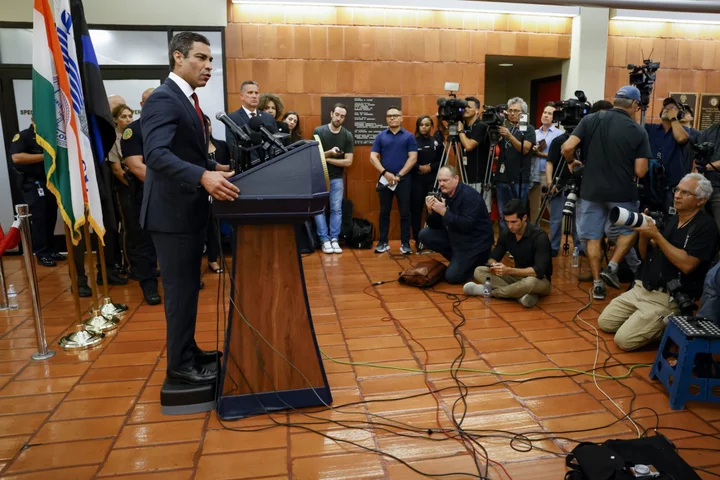
Miami Braces for Trump’s Court Date and Crowds of Up to 50,000
Between Al Capone, telenovela stars and a long list of narcos, Miami has had a long history of
2023-06-13 05:57

Texas House of Representatives votes to impeach Attorney General Ken Paxton
The Texas House of Representatives has voted to impeach Attorney General Ken Paxton.
2023-05-28 05:53
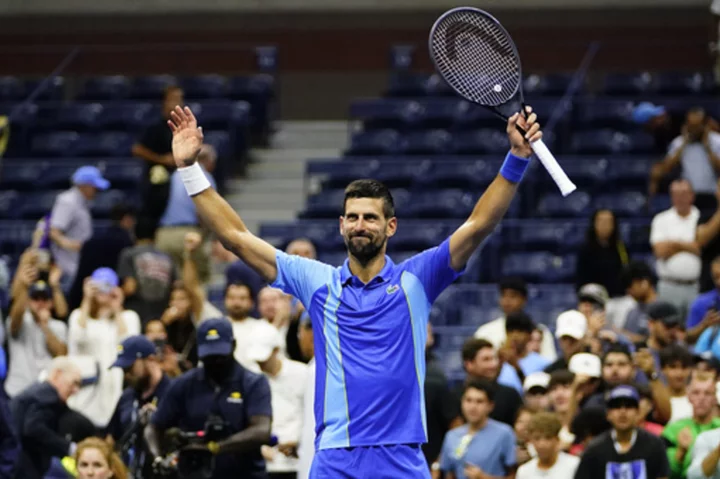
Novak Djokovic wins in his return to the US Open to ensure he will regain the No. 1 ranking
Novak Djokovic has made a winning return to the U.S. Open
2023-08-29 13:04

KB Home Announces the Grand Opening of Two New Communities in a Desirable Commerce City, Colorado Master Plan
COMMERCE CITY, Colo.--(BUSINESS WIRE)--Jul 21, 2023--
2023-07-21 20:00
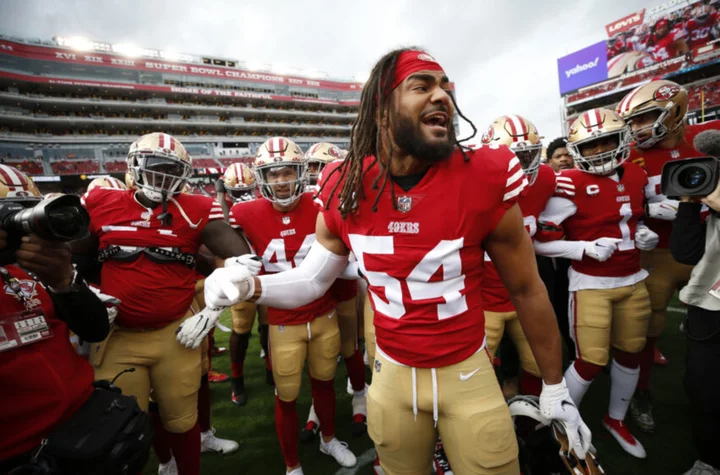
Fred Warner has an old cliché for anyone doubting 49ers quarterbacks
49ers linebacker Fred Warner is not making any excuses for his team this season regardless of who plays at quarterback.The San Francisco 49ers' narrative last postseason was all too familiar: head into the playoffs on a high note, get decimated by injuries, and bow out to a better team....
2023-05-22 22:14

Fast & Furious cast pays tribute on 10th anniversary of Paul Walker's death
The cast of the Fast & Furious franchise have been paying tribute to the late Paul Walker on the 10th anniversary of his death. The actor who played undercover police officer turned street racer Brian O'Connor in the action film series, died aged 40 in on November 30 2013 after the Porsche Carrera GT he was a passenger in crashed at a speed of more than 100mph in Los Angeles, according to a coroner's report in 2014. Walker's friend and financial adviser Roger Rodas who was driving the car also passed away from the crash. No drugs or alcohol were detected in either Walker or Rodas and both were pronounced dead at the scene, combined traumatic and thermal injuries were the cause of Walker's death, while Rodas died of multiple traumatic injuries. Walker was also known for roles in She's All That (1999), Varsity Blues (1999), Into The Blue (2005) and Joy Ride (2001). Following the success of 2001's Fast & Furious film, Walker returned to the role in 2003 for the sequel 2 Fast 2 Furious, and seven years later reprised his role once more for Fast & Furious (2009), Fast Five (2011), Fast & Furious 6 (2013). Most of Walker's scenes had been filmed for Furious 7 (2015) before his sudden death, but questions remained on how the film would continue. With the release date pushed back for a year, the ending was changed to pay tribute to Walker and his character which saw O'Connor retire. Archived footage of the actor from previous outtakes or shots from earlier Fast & Furious films were repurposed to complete the film, according to Screen Rant. Walker's brothers Caleb and Cody performed his scenes and their faces were replaced with CGI versions of Paul in post-production. Since Walker's death, a foundation has been set up in his honour - The Paul Walker Foundation - by his daughter Meadow Walker. For the 10th anniversary of Walker's death, Fast & Furious co-star Vin Diesel posted a heartwarming message along with a photo of the late actor with Diesel's daughter which he described as "one of my favourite images ever taken". "After ten years… I know these days of beautiful remembrance will be filled with tears," Diesel wrote. "But as time rolls on, with each year that passes… more smiles manage to break through the tears. Cause I know, when I see you again… our brotherhood will be stronger than we left it. Miss you." Jordana Brewster who played Walker's love interest Mia Toretto in the Fast & Furious franchise shared photos of the pair together on set - "10 years without you," she wrote in the caption. While Walker's daughter, Meadow Walker shared a sweet video of her younger self surprising her father. Before giving her a hug he says in the clip: "You just scared the hell out of me. What the hell are you doing? No way! No way!" "10 years without you… I love you forever," Meadow added in the post caption. Meanwhile, Fast & Furious fans have also been paying tribute to Walker on social media a decade on from his passing. How to join the indy100's free WhatsApp channel Sign up to our free Indy100 weekly newsletter Have your say in our newswere democracy. Click the upvote icon at the top of the page to help raise this article through the indy100 rankings.
2023-12-01 17:38
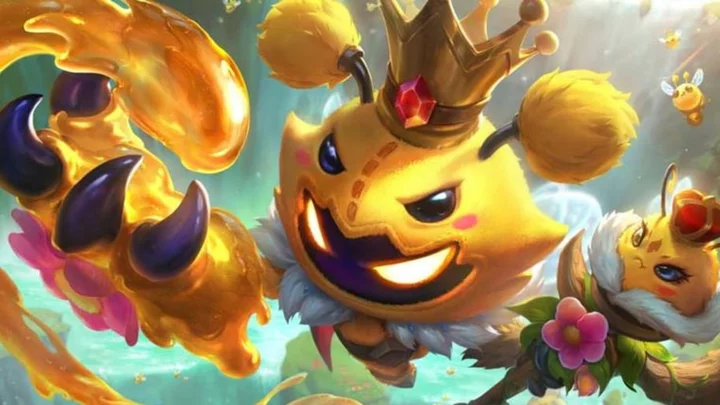
LoLdle Answers Nov. 30: Classic, Quote, Ability, Splash, Emoji
LoLdle answers for Nov. 30 across all formats including Classic, Quote, Ability, Splash and Emoji.
2023-11-30 23:46
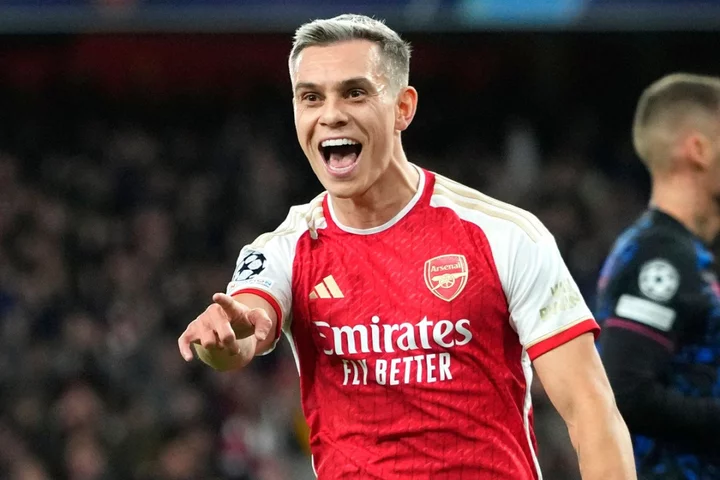
Leandro Trossard discusses Arsenal role under Mikel Arteta: ‘I will never back down’
Leandro Trossard insists he will not “back down” from the challenge of playing in a number of different roles in Arsenal’s forward line. The Belgium international started as Mikel Arteta’s central striker against Sevilla on Wednesday night and opened the scoring in a 2-0 victory that all-but assures the Gunners a place in the Champions League last 16. Trossard, who now has five Arsenal goals across all competitions this season, finished a sweeping move which saw Bukayo Saka square for him to tuck home before the England forward made sure of the win in the second half – although Saka then limped off late on to give Arteta another fitness worry. While he has mainly been deployed off the flanks since signing from Brighton in January, Trossard stepped up to play through the middle with Gabriel Jesus and Eddie Nketiah ruled out with hamstring and ankle injuries respectively. “I always need to be switched on to be honest,” he replied when asked how demanding it can be to play in different positions. “I always need to know my role. But I like it, I will never back down from anything. If you put me as a striker, or a winger or a number 10, I will always play my game I think. “He (Arteta) knows I like to swap positions as well during the game. We have those type of players as well and it creates a bit of chaos for the opposition team. I like it. I am really happy. I always need to know my role. But I like it, I will never back down from anything Leandro Trossard “It is always a nice feeling when you score, but when you do it in a Champions League game it’s always a nicer feeling. It gave us a lead and I think we played brilliantly.” Arsenal went into the game having lost two matches in a row, suffering a Carabao Cup fourth-round exit at West Ham before their first Premier League defeat of the season came at Newcastle on Saturday. Trossard, though, insists the players were never concerned about the prospect of it becoming a hat-trick of losses as they took control of Group B. “We are never worried because we know our quality and we knew we had to bounce back,” he added. “I think that made us start the game so well with a lot of aggressiveness and when the goal came it was a relief for us. Then from that moment we controlled the game. “We are always confident. We want to win every game and that’s how we approach them. We will try and win the next two games as well. “The manager just wanted us to attack when we had the ball, to get the ball to the wingers. Bukayo and Gabi (Martinelli) are so good one-v-one – then you see you can create a lot of chances. We did it so well.” Read More How can Man United qualify in Champions League? Bukayo Saka and Gabriel Martinelli dazzle to lead Arsenal towards last-16 Mikel Arteta provides Bukayo Saka injury update after concerning knock Champions League: What do Man United, Newcastle and Arsenal need to reach last 16? Jonas Eidevall hits back at Gareth Taylor over ‘bullying’ claim: ‘It’s slander’ Rumours: Chelsea and Man Utd want £43m full-back as Arsenal delay Toney chase
2023-11-09 20:42

Kane strikes as Bayern defeat struggling Man United
Harry Kane scored from the penalty spot as Bayern Munich piled more misery on struggling Manchester United with a 4-3 home win in...
2023-09-21 05:19
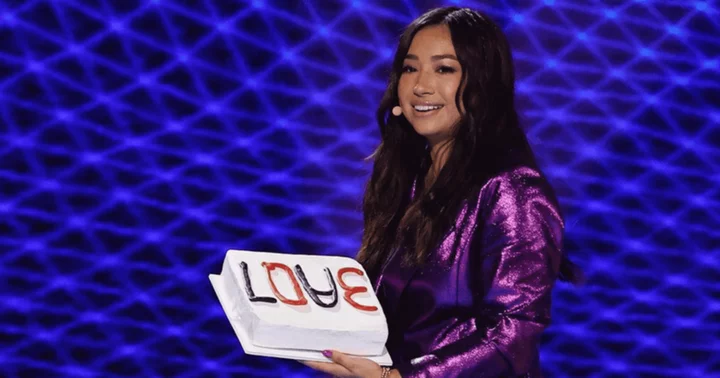
'AGT' Season 18: Viewers disappointed as Anna DeGuzman becomes first woman magician to move to finals
'AGT' fans call Anna DeGuzman 'not a real magician' as Jersey girl moves to finals
2023-09-14 11:11
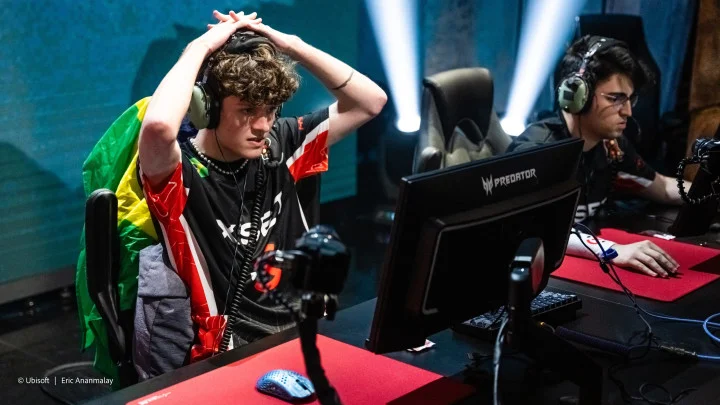
XSET Rainbow 6 Coach Suspended 12 Months for 'Major Misconduct' at Charlotte Major
XSET Rainbow Six Siege head coach Matheus "Budega" Figueiredo has been suspended from competitive action for 12 months after engaging in "major misconduct."
1970-01-01 08:00
You Might Like...
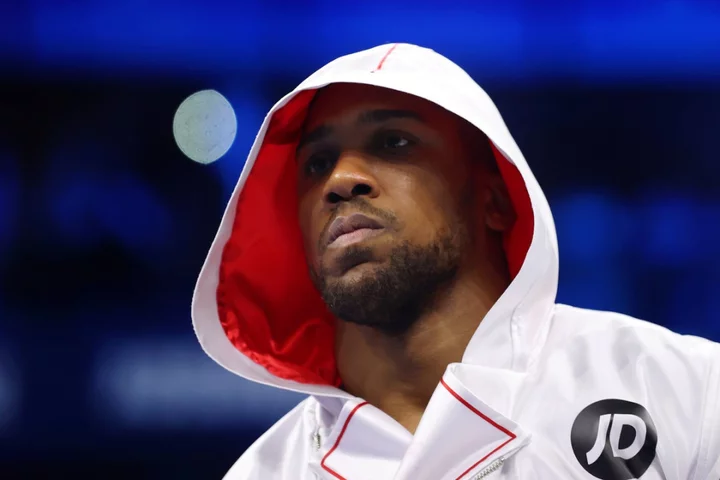
Boxing’s heavyweight saga sees biggest plot twist yet

UK Inflation Overshoots Again, Heaping Pressure on BOE
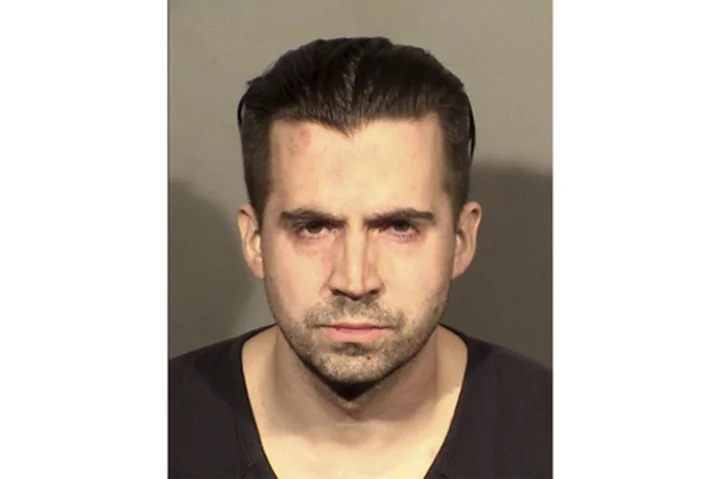
Jurors hear opening statements in $165k casino heists trial of Las Vegas police officer
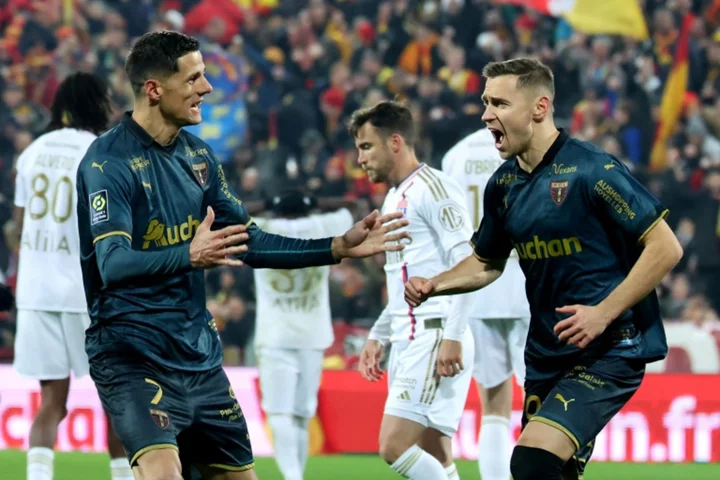
Lens inflict more pain on managerless Lyon
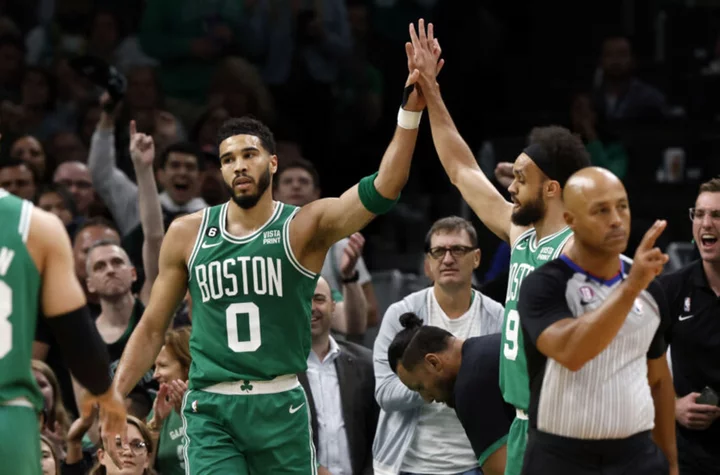
Celtics withstand the Heat in Game 5, send series back to Miami: Best memes, tweets
Natalie Portman wrote about ‘grieving wife’ day before husband Benjamin Millepied's affair came to light
Tesla, Saudi Arabia in early talks for EV factory - WSJ
Karim Benzema agrees Al-Ittihad contract