

Hong Kong July retail sales up 16.5%, boosted by tourism revival
HONG KONG Hong Kong's July retail sales rose 16.5% from a year earlier in the eighth consecutive month
1970-01-01 08:00
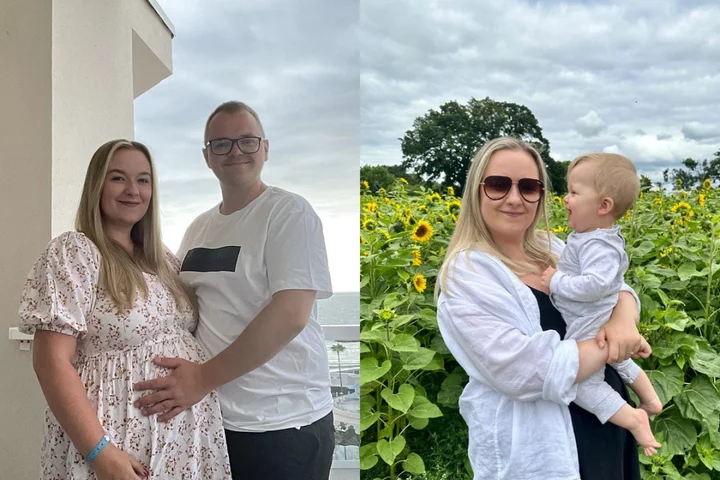
Terminally ill mum wants ‘happy memories’ with family after hand numbness turned out to be deadly disease
A mum who was told she likely suffered from carpal tunnel syndrome after feeling numbness in her right hand during her pregnancy has been given just a few years to live after scans revealed she will soon be paralysed. Charlotte Parker, 28, from West Berkshire, was diagnosed with amyotrophic lateral sclerosis (ALS) nine months after giving birth and is now trying to create “happy memories” with her young family while there is still time. The rare condition, a type of motor neurone disease (MND), means Charlotte only has two to five years’ life expectancy during which time she will become increasingly paralysed. Charlotte, who lives in Thatcham with her fiance George, 32, a mechanic, and their three children, says she wants her 11-month-old son Jimmy to know she was there. Her friends and family are fundraising so she can afford to take her family to Disneyland in Paris and take advantage of what time they have left together. “I don’t think you can imagine having to tell your parents at 28 that you have been diagnosed with a terminal illness,” Charlotte, who works as a revenue and debt accountant at an energy company, told PA Real Life. “At the moment my life is so fast paced that I don’t really have much time to slow down and think about what’s happening. “Most people think MND-ALS affects older people but it actually affects a wide range of people. It can happen to anyone.” Charlotte was seven months’ pregnant when she began feeling a strange “numbness and weakness” in her right hand. “I was struggling to open jars and bottles,” she said. “Gradually it just got worse and worse and by the time I gave birth to Jimmy, I was considerably weaker. “Doing day-to-day tasks while trying to learn how to look after a newborn baby was definitely a challenge.” After flagging the numbness to her midwife, Charlotte was told she likely suffered from carpal tunnel syndrome, a common health condition caused by pressure on a nerve in the wrist. But Charlotte was referred to a neurologist when she went for a routine checkup six weeks after Jimmy was born. “He sent me for an MRI in January for possible inflammation in the brain,” she said. “I think subconsciously at the time that’s when I knew it was something a bit more serious.” While Charlotte was worried, her results came back and suggested there was no problem with her brain or spinal cord. Instead of getting better, however, the numbness started to spread to her other hand. “I kept calling because it started going into my left hand as well,” she said. “I am still able to move my fingers in my left hand but my right hand does not really work anymore.” In June, Charlotte was given an electromyography, a medical test which looks at how a person’s nerves and muscles respond to stimulation. “They put stickers on you and send pulses up your arm,” she said. “I got called in to see the neurologist quite quickly after that, which is when he advised that he strongly believed that it was MND-ALS.” I want to do as many days out with the children as possible so that we have those memories all together. Charlotte Parker ALS, the most common motor neurone disease, is incurable and causes progressive weakness and paralysis, usually leading to death within three to five years, the National Institute of Neurological Disorders and Stroke said. Charlotte’s worst fears were confirmed after she visited John Radcliffe Hospital in Oxford in July and was formally diagnosed. “It’s been a lot to adjust to, especially with a four(-year-old), seven(-year old) and eleven-month-old,” she said. “To know that there is no cure or treatment that will give me a substantial lease of life. “It is just going to deteriorate pretty quickly.” Charlotte broke the devastating news to her family and friends that her illness is terminal. “My youngest is completely none the wiser and the girls are aware that my hands are getting weaker and that it will move to my legs, but we haven’t gone into the detail of what it means will happen.” Unfortunately, doctors are unable to say how quickly Charlotte’s condition is progressing. “Each person’s story is different,” she said. “It’s such a maze on how one person’s body deteriorates to the next.” But Charlotte is not letting the diagnosis get in the way of her family plans. The mum, who does not have life insurance, plans on continuing to work for “as long as possible”. “I am fortunate that my work provides death in service,” she said. “If I can, I will try and work for as long as possible so that my partner and children do have something to help them for the next however many years.” She also plans on marrying the “love of her life”, George, after getting engaged two years ago and falling pregnant. “I fell pregnant and it just got pushed to the side. I didn’t want to get married nine months’ pregnant,” she said. “It’s time for us to celebrate us as a couple rather than just accepting that we’re not going to be together for the rest of our lives. “We have to make good of what we can and celebrate what we do have, right now, rather than just accepting the situation.” The couple, who recently went on holiday to Pembrokeshire, are also looking to create “happy memories” while there is still time. “We were on the beach late evening, when it was raining and full of wind, and we were taking photos running in and out of the sea to make memories,” she said. “I want to do as many days out with the children as possible so that we have those memories all together. “Even silly things, like being there for Jimmy’s first haircut and taking him to feed the ducks so that we can capture those memories and that he knows that I was there.” Charlotte’s friends have set up a fundraiser on GoFundMe to help them cover their costs, including a trip to Disneyland, Paris. “It would be a great trip to have with them,” she said. “I just want to enjoy my family and do as much as I can with them because there will come a point where even though I’m around, it will be a lot more complicated.” They have so far raised £11,235 of their £15,000 target. Charlotte continued: “A huge thank you to anyone who can help and it will go to creating some of the best memories I can with my family before the inevitable does happen.” To support Charlotte, visit: www.gofundme.com/f/complete-her-wishes-with-her-family Read More Woman’s blood cancer misdiagnosed as carpal tunnel due to burning hand pain What happens to your brain when you’re pregnant? Cyclist completes 960-mile ride to remember friends who died from MND What is sickle cell disease and how do you know if you have it? Project launched to bust myth that cancer is a ‘white person’s disease’ Man who lengthened his limbs by three inches says he feels ‘so much happier’
1970-01-01 08:00

After Credit Suisse takeover, UBS begins cost drive by axing 3,000 Swiss jobs
By Noele Illien and Oliver Hirt ZURICH (Reuters) -UBS Group embarked on a sweeping plan to cut more than $10
1970-01-01 08:00

Exclusive-Chinese exporters using currency swaps to retain dollars as yuan sags
SHANGHAI/SINGAPORE Chinese exporters are using a complicated currency swap strategy to avoid converting their dollar earnings into yuan
1970-01-01 08:00

UBS to cut 3,000 jobs after Credit Suisse takeover
The Swiss bank reports bumper profits following the rescue of its rival but staff face redundancies.
1970-01-01 08:00

Europe's inflation held steady in August as European Central Bank keeps an open mind on rates
Inflation paused its decline in Europe in August
1970-01-01 08:00

Inflation in Europe stuck at 5.3% in August
Consumer prices in the 20 countries that use the euro rose 5.3% on average this month compared with a year ago, preliminary estimates by Europe's statistics office showed Thursday.
1970-01-01 08:00

Stock market today: Global shares trade higher ahead of US updates on inflation and hiring
Global stock markets are mostly higher ahead of updates on United States inflation and hiring that traders hope will persuade the Federal Reserve no more interest hikes are needed
1970-01-01 08:00

A dead vampire star is firing out 'cosmic cannonballs'
A dead “vampire” star is feeding on a nearby companion and expelling cannonballs and its behaviour has left astronomers stunned. The dead star is located around 4,500 light-years away and, until now, has baffled astronomers with its unusual behaviour. It is a rapidly spinning neutron star, otherwise known as a pulsar, that has been given the name PSR J1023+0038, shortened to J1023. It emits radiation from both its poles that occasionally reach Earth and also appears to have two different “settings” of brightness. Initially, the behaviour of J1023 confused experts, but now they believe that the stark difference in brightness levels has to do with the star launching out matter over short spaces of time. Maria Cristina Baglio, leader of the research team and scientist at New York University, Abu Dhabi, said in a statement: “We have witnessed extraordinary cosmic events where enormous amounts of matter, similar to cosmic cannonballs, are launched into space within a very brief time span of tens of seconds from a small, dense celestial object rotating at incredibly high speeds.” In addition to the pulsar emitting matter, over the last 10 years, scientists have witnessed the star pulling material from its companion star. The material it is stealing forms a structure called an accretion disk that forms around the star itself. Since it began feeding, the star has been alternating between between “low” and “high” power modes. During moments of high power, the star shines brightly with a variation of X-rays, ultraviolet and visible light. During low power, it emits radio waves and appears much dimmer. In June 2021, experts witnessed a star shooting out hot, luminous matter that has been compared to a cosmic cannonball as the star continually switched modes. J1023 has fascinated experts, who have been able to explain the way the star behaves by observing it. Despite solving many of its mysteries, the scientists aren’t done with it yet. With the Extremely Large Telescope (ELT) in northern Chile currently under construction, it is hoped that when it is ready, scientists will once more be able to observe the pulsar. Sergio Campana, research co-author and Research Director at the Italian National Institute for Astrophysics Brera Observatory, said: “The ELT will allow us to gain key insights into how the abundance, distribution, dynamics and energetics of the inflowing matter around the pulsar are affected by the mode switching behavior.” Sign up to our free Indy100 weekly newsletter Have your say in our news democracy. Click the upvote icon at the top of the page to help raise this article through the indy100 rankings.
1970-01-01 08:00

Gary Oldman cast in Paolo Sorrentino's new Naples movie
Gary Oldman has landed a part in Paolo Sorrentino's new film which is described as a love letter to his home city of Naples.
1970-01-01 08:00

Thailand's economic recovery on track but exports weigh
BANGKOK Thailand's economic recovery remained on track in July as private spending increased and the tourism sector expanded
1970-01-01 08:00

Project launched to bust myth that cancer is a ‘white person’s disease’
More must be done to get black, Asian and ethnic minority people to participate in breast cancer trials, experts have said, as they warned that people from these backgrounds have been under-represented in previous studies. Medics said that they want research into the disease to be “relevant to people we see in the clinic”. Experts said that there is a “broad misperception” that black women “don’t suffer as much from breast cancer” which can result in the perception that “cancer is a white person’s disease”. If I hadn’t gone on the trial at The Christie, I wouldn’t be here today Jasmin David This is despite the fact that previous studies have found that black women are more likely to die from breast cancer compared to their white peers. They are also more likely to develop more aggressive cancer and be diagnosed when their cancer is at a more advanced stage. It comes as the NHS Race and Health Observatory launched a new campaign alongside Macmillan Cancer Support to improve diversity in breast cancer clinical trials. The project, which is being supported by Roche, aims to raise awareness of the lack of diversity in clinical studies, improve communications and provide longer term support to patients. Specialist nurses will be provided at two major cancer hubs – Bart’s Health NHS Trust in London and The Christie NHS Foundation Trust in Manchester – to help guide patients through the process. Men, who account for 1% of breast cancer patients in the UK, are also being included. The NHS Race and Health Observatory said that there are “multiple barriers” around the recruitment, communication and retention of black, Asian and ethnic minority patients in clinical trials. It said that data show that people from an ethnic minority background are poorly under-represented in many clinical trials. And the Caribbean African Health Network said that there has been a “disengagement” in research “as a result of mistrust”. Jasmin David, a 53-year-old breast cancer patient from Fallowfield in south Manchester, took part in a clinical trial which saved her life and is encouraging others to do the same. Two years after her initial diagnosis and treatment at The Christie she was told that the cancer had come back and had spread to her lungs, lymph nodes and chest bone. The mother-of-two was told she had less than a year to live but was also offered the opportunity to take part in a clinical trial at the National Institute for Health and Care Research Manchester Clinical Research Facility. Ms David is now cancer-free. “If I hadn’t gone on the trial at The Christie, I wouldn’t be here today,” she said. “I have two children and now I get to be there for them as they grow up. “Research gave me a second chance and life and I’m relishing every second of it. “I want everyone, no matter their ethnicity, to have equal access to clinical trials, so I’m glad that this important piece of work is being done. I hope that by sharing my story I can inspire more women like me to come forward and take part in clinical trials.” Dr Habib Naqvi, chief executive of the NHS Race and Health Observatory, said: “We are pleased to announce this partnership and our joint commitment to ensuring inclusion and representation in future breast cancer trials. “We believe that when targeted, culturally sensitive interventions and communications are put in place, under-represented groups can be successfully recruited into clinical trials.” He added: “There is a broad misperception that black women don’t suffer as much from breast cancer or it does not run in their family history. This can result in the perception that cancer is a white person’s disease. “We want this pilot to encourage women at risk, those already diagnosed and individuals undergoing post treatment to come forward and share their experiences and get the information needed.” Professor Richard Simcock, chief medical officer at Macmillan Cancer Support, added: “As a Breast Cancer Oncologist I want to know that research is relevant to the people we see in clinic. Historically that has not been the case. “I’m delighted that Macmillan can support this project to ensure that future evidence from clinical trials is representative and inclusive.” Charles Kwaku-Odoi, chief executive of the Caribbean African Health Network, said: “Across the black community there is an undoubted legacy of disengagement in research and most certainly clinical trials that stems back decades as a result of mistrust. “This has not served us well because it leads to a lack of appropriate interventions that perpetuate the grave health inequalities in breast cancer care. “This partnership approach to build solutions to improve engagement in clinical trials in breast cancer treatment and care is very much welcomed. We are looking forward to working in a collaborative way to build trust, improve awareness and ensure that barriers surrounding access to clinical trials are addressed.” Read More Charity boss speaks out over ‘traumatic’ encounter with royal aide Ukraine war’s heaviest fight rages in east - follow live 10 slick ways to kit out your student digs 4 essential officecore trends to update your work wardrobe Sickle Cell Awareness Month: What is sickle cell disease and how do you know if you have it?
1970-01-01 08:00