

Man City injury crisis: The players Pep Guardiola is missing
The injury list affecting Manchester City and manager Pep Guardiola, with Kevin De Bruyne among those absent.
1970-01-01 08:00

Daniel Levy explains details of Tottenham's 'buy-back clause' for Harry Kane
Daniel Levy has explained the details of Tottenham's buy-back clause for Bayern Munich striker Harry Kane.
1970-01-01 08:00

Cisco beefs up cybersecurity play with $28 billion Splunk deal
(Reuters) -Cisco Systems has agreed buy cybersecurity firm Splunk for about $28 billion in its biggest-ever deal to beef up
1970-01-01 08:00

South Africa to clear Covid lockdown criminal records
More than 400,000 people were arrested for breaking some of the world's toughest lockdown restrictions.
1970-01-01 08:00
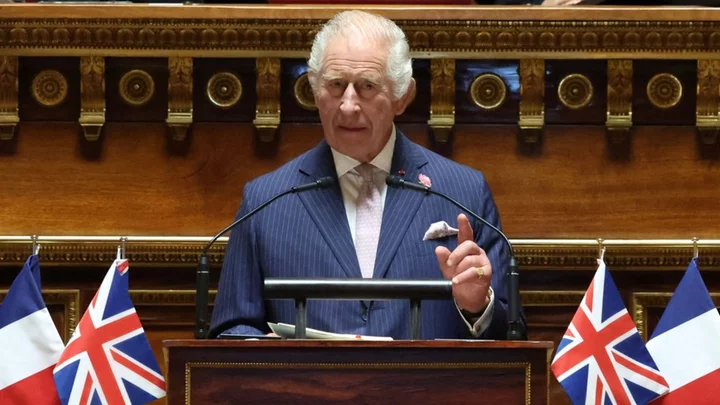
King's diplomatic speech to French Senate receives standing ovation
His speech, delivered in French and English, touched on climate change and the invasion of Ukraine.
1970-01-01 08:00
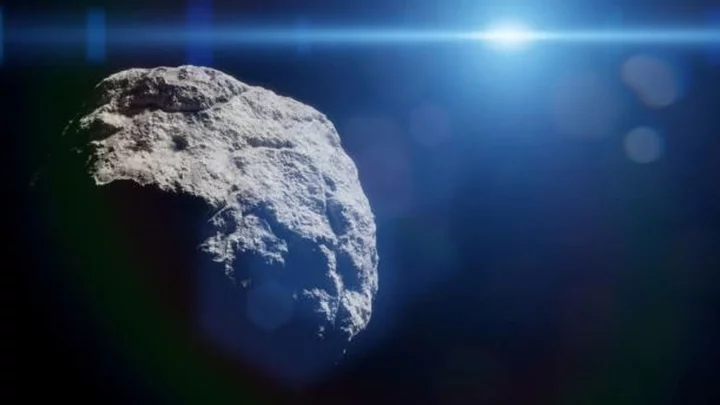
Scientists issue warning about asteroid heading to Earth with force of 24 atomic bombs
Scientists are on alert after NASA confirmed there is a chance an asteroid the size of the Empire State Building could come smashing into Earth. The asteroid is named Bennu after the ancient Egyptian bird god and has been on the space agency’s radar for a long time as they try to prevent it from coming crashing into our planet. Bennu has been categorised as one of the two “most hazardous known asteroids” and, despite the chance of impact standing at 1-in-2,700, it could strike the Earth with the force of 24 times that of the largest nuclear bomb – 1,200 megatons of energy. The carbon-based asteroid is approximately 510 metres wide and experts predict that it will come closest to hitting Earth on September 24, 2182. While the asteroid is quite sizeable, it is not quite as sizeable as the six-mile-wide asteroid which almost completely wiped out the dinosaurs. But, NASA warns that Bennu “could cause continental devastation if it became an Earth impactor”. A space mission launched using NASA’s OSIRIS-REx spacecraft has successfully taken a sample from Bennu in order for scientists to better understand the potentially dangerous asteroid. On Sunday (24 September) a capsule of the material will be dropped by OSIRIS-REx and returned to Earth where it will be retrieved and the matter inside studied. Davide Farnocchia of NASA's Jet Propulsion Laboratory told the Science Journal: “We improved our knowledge of Bennu's trajectory by a factor of 20.” As scientists work to investigate how much of a risk it could cause, Farnocchia added: “In 2135, we'll know for sure.” Sign up to our free Indy100 weekly newsletter Have your say in our news democracy. Click the upvote icon at the top of the page to help raise this article through the indy100 rankings.
1970-01-01 08:00

Who is playing college football tonight, Sept. 21?
The college football season is in full swing with exciting upsets and thrilling matchups. Check out the Week 4 games scheduled for Thursday, Sept. 21.
1970-01-01 08:00

Bayern Munich lands opening blow on Manchester United in the Champions League
Bayern Munich lands opening blow on Manchester United in the Champions League
1970-01-01 08:00

Erik ten Hag: Man Utd made it easy for Bayern Munich
Erik ten Hag admits that Manchester United need to "look in the mirror" after losing their fourth game of the season against Bayern Munich.
1970-01-01 08:00

Chelsea defender suffers injury setback on return to training
Chelsea defender Benoit Badiashile suffered an injury setback on his return to training.
1970-01-01 08:00

US offers almost 500,000 Venezuelans legal status
US cities have been grappling with large numbers of Venezuelans fleeing economic and political turmoil.
1970-01-01 08:00
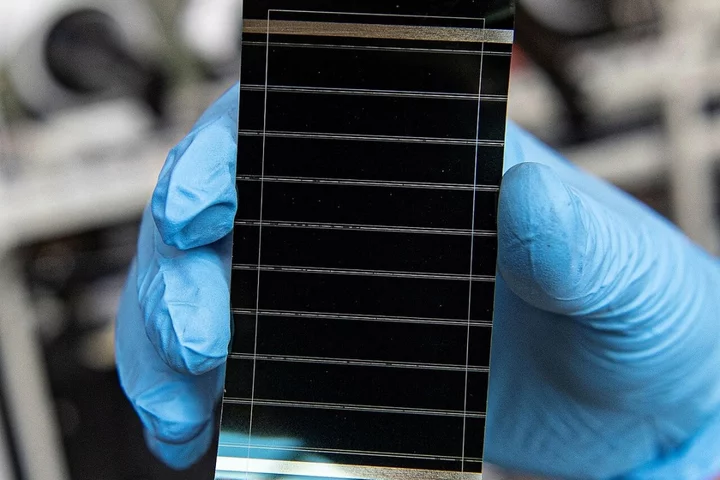
Solar panel breakthrough could supercharge ‘miracle material’ production
Scientists have made a major breakthrough with a new type of solar panel that they claim could supercharge the transition to renewable energy sources. A team from the University of Surrey discovered that a nanoscale “ink” coating could improve stability enough to make next-generation perovskite solar cells suitable for mass production. Perovskite is cheaper and lighter than conventional silicon-based cells, as well as far more efficient, however the emerging technology currently suffers from a drop in efficiency and energy output during the manufacturing process. “Performance limits of traditional solar cells are why researchers are switching to examining perovskite as the next-generation solar technology, especially as applications both terrestrial and in space are rapidly growing,” said Dr Imalka Jayawardena from the University of Surrey’s Advanced Technology Institute (ATI). “Our key development in solar panel technology shows a cost-effective approach to scaling of perovskite solar cells, a development which could help countries around the world to reach their net zero targets faster.” The breakthrough was made when the researchers identified an aluminium oxide that minimises the drop in efficiency during the conditioning of perovskite solar cells. Perovskite has been hailed as a “miracle material” for its potential to transform an array of industries, from ultra high-speed communications to renewable energy. Recent advances have seen it used to create self-healing solar panels that can recover 100 per cent of their efficiency after being damaged by radiation in space, as well as break new efficiency records when combined with silicon to form tandem cells. If the cheap-to-produce perovskite cells can be manufactured at scale while retaining their durability and reliability, then the cost of solar panels would plummet. “Solar and wind energy costs are rapidly decreasing based on technology improvements, to the level where worldwide over 80 per cent of all new additional power generation capacity is based on renewables,” said Ravi Silva, from the ATI, University of Surrey. “The levelized cost of solar electricity is now cheaper than most other power-generating sources. With the maturing of perovskite solar modules, the levelized cost of electricity will significantly decrease further, and that is why this is such an exciting area to work.” The research was detailed in a study, titled ‘Modification of Hydrophobic Self-Assembled Monolayers with Nanoparticles for Improved Wettability and Enhanced Carrier Lifetimes Over Large Areas in Perovskite Solar Cells’, published in the peer-reviewed scientific journal Solar PRL. Read More Hundreds of years after it was discovered, one material is about to change the world ‘Miracle material’ smashes solar panel efficiency threshold Scientists invent solar panels that work in a snow blizzard September Supermoon: When is it and how to view it? Amazon Alexa is getting the same brain as ChatGPT
1970-01-01 08:00