
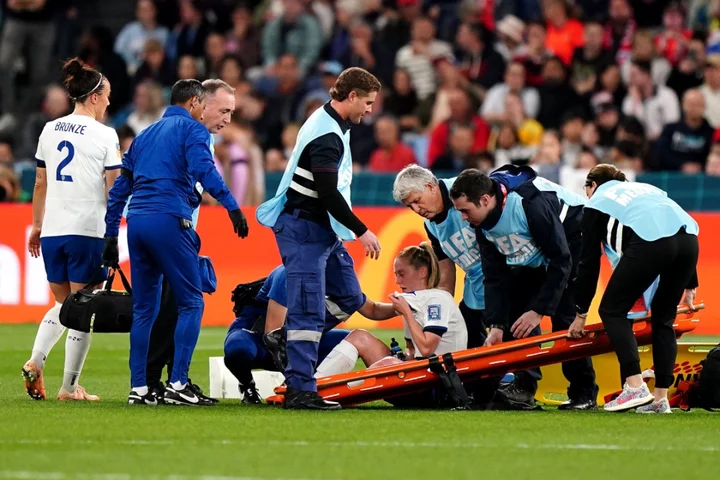
Keira Walsh adds to England’s long injury list after coming off against Denmark
Keira Walsh added to England’s injury woes when she went down in the first half of the World Cup Group D game against Denmark. Here the PA news agency takes a look at some of the key players missing in England’s World Cup campaign. Keira Walsh Walsh stayed down after stretching to intercept a pass in midfield and could clearly be seen telling the team’s medical staff: “I’ve done my knee.” Play was stopped immediately, despite it not being a head injury, and England’s midfield metronome was carried off on a stretcher after a period of treatment. Laura Coombs took Walsh’s place as a substitute but a prolonged absence would be the latest significant blow to the Lionesses’ hopes of following up their European Championship win. Leah Williamson England captain Leah Williamson was ruled out of the World Cup after she ruptured her anterior cruciate knee ligament during Arsenal’s Women’s Super League defeat to Manchester United in April. Like Walsh, Williamson appeared to catch her studs in the turf with no other player in close proximity. A pillar at centre-back, Williamson has been an integral part of the England set-up and skippered the side to their first major trophy at Euro 2022. Beth Mead Williamson joined a long injury list at Arsenal which includes fellow Lionesses favourite Beth Mead, who has been out with the same injury since November. Mead caused havoc for opposition teams at last summer’s Euros, where she was named player of the tournament and was awarded the Golden Boot with six goals including a hat-trick in England’s 8-0 thrashing of Norway. Fran Kirby Kirby missed the tournament Down Under following a knee injury picked up in Chelsea’s Continental League Cup semi-final win at West Ham in February. The midfielder started every game of last summer’s European Championship campaign – providing three assists and scoring two goals as the Lionesses won on home soil – and scored nine times for Chelsea in 16 appearances across all competitions last season. Read More Charity boss speaks out over ‘traumatic’ encounter with royal aide Ukraine war’s heaviest fight rages in east - follow live Ryan Reynolds reaches out to Manchester United keeper after Paul Mullin injury Football rumours: Bayern Munich officials fly to London in bid for Harry Kane British Cycling set to debut Olympic bike at World Championships
1970-01-01 08:00
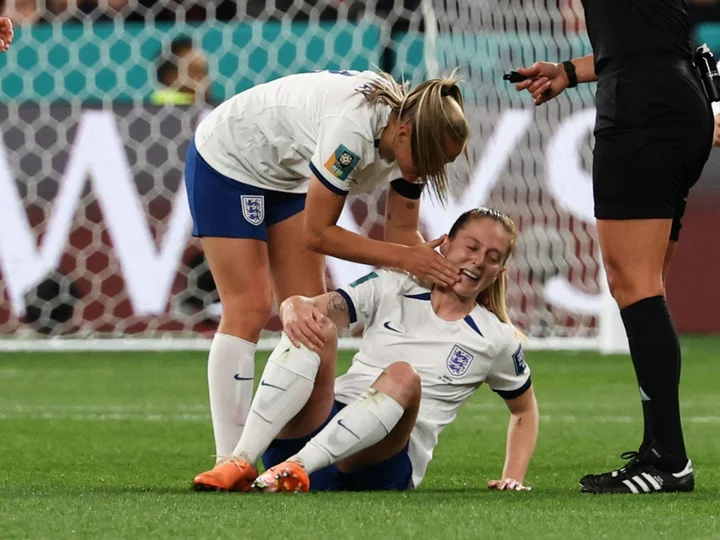
England sweat on Keira Walsh fitness amid avalanche of ACL injuries impacting Women’s World Cup
ACL injuries have already influenced the Women’s World Cup with the contenders weakened after a number of key players were ruled out in the build-up to the tournament in Australia and New Zealand. Players are asking why the injury has been so prevalent in women’s football, including glaring omissions of Netherlands forward Vivianne Miedema, England's Leah Williamson and Beth Mead, Canada's Janine Beckie and rising USA star Catarina Macario in this tournament. And now the Lionesses will be forced to sweat on the health of Keira Walsh, who suffered a knee injury to be forced off against Denmark. The Barcelona midfielder was taken off on a stretcher, replaced by Laura Coombs, and appeared distraught, covering her face with her hands. "I'm devastated for her to be honest,” said Ellen White on BBC Sport. “She's been one of the best if not the best player for England. She knew it didn't look good. She'll be a big miss. Laura has come in, I'm devastated for her." While Jonas Eidevall added that the dry pitch may have contributed to the injury: “It's a danger to player welfare to have such a dry pitch. It's not good enough. I'm a big advocate of watering the pitches, it makes the ball go faster and stops situations like this.” USWNT midfielder Andi Sullivan, who tore her ACL in college at Stanford, believes it is a “multifaceted issue” hurting the game. “I don’t know if I’m the expert in it, even though I’ve experienced it,” said Sullivan. “There’s so many different factors that could contribute to that and I think we are a little bit behind on the research as to why, so hopefully now the prevalence will kind of wake people up,” Sullivan added. “This is an issue we need to pay attention to and look more into preventing and how to handle it better.” Last year it was estimated that nearly 60 players in the world's top professional women's leagues were sidelined because of anterior cruciate ligament injuries. Among them was Spain's Alexia Putellas, who injured her ACL just before the Euros last July. Putellas, who will play for Spain at the World Cup, partnered with FIFPRO, the international players' union, to call attention to the outbreak of ACL injuries and demand a closer look at possible contributing factors including workload, medical care, field conditions and even equity. Studies have shown women are up to eight times more likely to suffer ACL injuries in sports involving sudden changes of direction, like soccer and basketball, than their male counterparts. Dr. Mark Cullen, the team physician for the University of New Hampshire who specializes in orthopedic surgery, says women have wider hips which impacts knee mechanics. “They also tend to land a little bit more stiff-legged and don’t absorb the forces as well as their male counterparts, and that puts more force on the ACL and contributes to the tears,” Cullen said. Katie Rood, who plays professionally in Scotland, was hoping to make New Zealand's roster and play in soccer's biggest tournament on home soil. But she recently announced that she had joined the “ever-growing ACL club.” “It’s been an interesting process so far and one I’m sure I’ll learn a lot from, especially as it’s a serious issue in the women’s game. What’s hit me quite hard in this situation is just how many times I’ve been asked ‘Is the club looking after you?’” she wrote. “It’s a reminder that health care and medical treatment isn’t often the norm in the women’s game and we all know of players being left to fend for themselves after getting seriously injured with their clubs.” Rood, however, praised her team for their support. Miedema won’t be ready in time to help the Netherlands when it returns to the Women's World Cup after finishing as runner-up to the United States four years ago in France. She is one of four players from Arsenal in the Women’s Super League currently sidelined by ACL injuries. The list includes Williamson, who tore her ACL in April. When Arsenal’s Laura Wienroither tore her ACL earlier this month, Miedema posted on social media: “At least we will all be in the gym together. PS. ACL group is full now. Please no more.” Five of the nominees the 2022 women's Ballon d’Or — Putellas, Miedema, Macario, Mead and France’s Marie-Antoinette Katoto — all sustained ACL injuries last year. Mead, who won the Golden Boot at the Women's Euros last year, was left off England's 23-player roster for the World Cup. “We have to take care of players and do what’s smart, and not do what’s a little bit naive,” England coach Sarina Wiegman said. Having already lost Katoto, France was dealt another ACL blow when Delphine Cascarino tore her ACL while playing for Lyon. Lyon teammate Macario, one of the most promising young U.S. attackers, tore her ACL last June. Macario rehabbed at Aspetar, a specialized sports medicine facility in Qatar, but announced in May that she wouldn't make it back in time for the World Cup. Aside from the mechanics, there's an emotional toll that such long-term injuries take on athletes. For some, it means the loss of a paycheck, for others it may be that their careers stall or are cut short. Others miss out on chances to play in the World Cup. Tierna Davidson, who plays for the Chicago Red Stars in the National Women's Soccer League, tore her ACL last March. She said the injury and the rehab helped her appreciate her career. “At the beginning, I felt like I was impatient and I was frustrated. When is this going to be over?” Davidson said. “But I think throughout the process, I really learned how to be patient and how to listen to myself and allow myself the space to enjoy the good things, which is important when you’re going through something like that.” Read More England vs Denmark LIVE: Women’s World Cup latest score after Lauren James goal and Keira Walsh injury Why are England wearing black armbands today? Who are the BBC World Cup commentators? Alex Scott, Fara Williams and full list of pundits Laura Coombs: England’s unlikely midfield general in profile Women’s World Cup groups: A comprehensive guide to each squad Women’s World Cup TV schedule: How to watch every match today
1970-01-01 08:00

Experts reveal the most unhygienic things in your kitchen – and how to get them clean
It’s likely there are countless things in your kitchen which look clean, but actually, they’re filthy. Could your dishcloths be making you sick? When was the last time you washed your tea towels? And do we really need to bleach the sink more than once a month? We asked an expert to find out. Knobs, door handles, and buttons The buttons and dials on your kitchen appliances could be a germ-fest. “People often neglect to clean these areas of the kitchen,” says Danielle Mason, a cleaning content creator – or ‘cleanfluencer’ – who creates tutorials and videos on TikTok and Instagram. “Most of the time, they don’t think it is important, but as you’re commonly handling raw meat and food, it’s extremely important to keep these areas clean, due to cross-contamination. “Always sanitise with a cloth – I like to do this with Zoflora, as it leaves a great smell afterwards, and kills bacteria from dirty fingers.” Cloths If what you clean with isn’t clean, chances are, your kitchen isn’t either. “I always leave my cloth to soak in bleach before going to bed every night,” says Mason. “This enables a new start in the morning with no bacteria. Also, make sure you’re replacing the cloths – I would suggest a new one every two weeks, whilst still bleaching every night. And make sure you’re not using this cloth on anything other than the kitchen, as you do not want to cross-contaminate.” Sponges Mason stresses sponges are unhygienic, as they’re constantly damp and can carry E. coli. “People tend not to use sponges, as they carry so many more germs, and even putting them in the microwave will not kill all of them. Avoid a sponge where possible.” Dish towels Dish towels and tea towels may not be changed anywhere near often enough. “You should have one for every day of the week, as they carry so many bacteria and germs, which get spread across the kitchen. If you’re drying pots and pans, and then wiping down your surfaces, it’s not good,” she says. Chopping boards Chopping boards – particularly wooden ones – could be a haven for bacteria. “You should have a different colour for different types of food, one for meat, fruit, and other foods,” advises Mason. “The best way to clean them is in a dishwasher, as it’s good to get rid of all the germs due to the very high heat. If you don’t like the dishwasher, then boil the kettle water and leave the chopping boards to soak in it. I use a steam cleaner on mine, as it kills 99.9% bacteria and there are no chemicals.” It is best to avoid wooden chopping boards altogether, as these cleaning methods may damage them. Kitchen sink “This is a massive breeder of bacteria and grime; a distinct microbiome is found in sinks. “The plumbing area found beneath sinks revealed microbial communities dominated by a group of bacteria called Proteobacteria. This phylum includes pathogens such as Salmonella and E. coli, which can cause serious disease,” Mason shares. “I’ve always been taught never to wash my hands in the sink, and to never throw dirty water down the sink. You wash your cups and plates in the sink and prepare food, so it should always be kept clean, and nothing from outside the kitchen should cross-contaminate that. For example, never wash your floors and put dirty water in your kitchen sink, always throw it down the toilet.” How do you possibly clean the inside of your sink and drains? “Baking soda and vinegar is the best way to clean your sink out, or bleach, but you must be careful with bleach, as it can stay in the bottom of your sink, depending on the material it’s made of. I clean my sink out every day.” Pipes and cupboards around your sink could be leading you to have a rodent problem. “You can prevent mice and rodents from entering the kitchen by covering any small crevices or cracks. It is also important to repair leaks as soon as they happen, as they can come through the pipes,” she says. Fridges “Deep clean [your fridge] every two months. A normal cleaning – the wiping of shelves – should be done every other day with soapy water. For any bad smells, use baking soda, which will absorb the smell from the fridge,” Mason continues. “The fridge is a breeding ground for salmonella, E. Coli and other bacteria.” Bins Where you throw your waste away could be a breeding ground for germs. “Make sure you keep [outdoor] rubbish bins away from your house, and make sure you empty your bin as soon as it’s full,” advises Mason. “I personally do not keep a bin in the kitchen, I use a bag and I take that out by the end of the day, but if you are using a bin, make sure you bleach it with hot kettle water, to keep it smelling fresh.” Read More This is why you keep waking up at 4am – and what you can do about it TV chef James Martin reveals cancer diagnosis in apology over ‘bullying’ allegations Bursts of activity that make you huff and puff ‘linked to reduced cancer risk’ Charity boss speaks out over ‘traumatic’ encounter with royal aide Ukraine war’s heaviest fight rages in east - follow live
1970-01-01 08:00
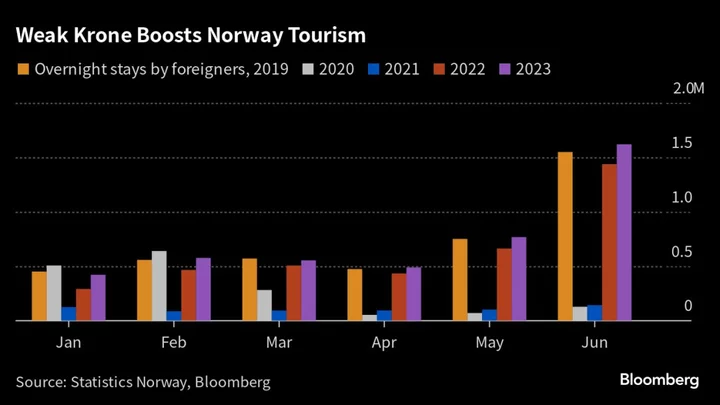
Norway Tourism Gets Boost From Foreigners on Krone
Norwegian tourism is thriving after a weaker krone made the famously expensive Nordic country cheaper to visit and
1970-01-01 08:00

Trump’s election fraud claims were always bogus. Will his history of lies finally catch up to him?
Former president Donald Trump’s attempts to undermine the results of elections that his rivals have won are now at the centre of a sprawling federal investigation, one that follows an avalanche of lies and conspiracy theories about the democratic process and a campaign to overturn the votes of millions of Americans. Lawsuits from his legal team and Trump allies were shot down in court. His own administration and campaign failed to produce any evidence. But his false and inflated claims, spanning more than a decade, have sowed enough doubt among his supporters to construct the lie of “stolen” and “rigged” elections, animating Republican attempts to challenge results and craft legislation to do what Mr Trump failed to do in the courts. A persistent lie that the election was stolen from him fuelled violence at the US Capitol on 6 January, 2021, sustained partisan investigations intended to reverse the outcomes in states he lost, inspired Republican-led legislation in nearly every state to change how elections are run, and has formed the basis of Mr Trump’s 2024 campaign. Did he believe the “truth” of his claims? And how often was he told, by both his advisers and White House officials, that he was wrong? These are questions that prosecutors are likely considering as US Department of Justice special counsel Jack Smith and his team weigh another federal indictment against the former president, but they won’t need to establish that he was aware that he was spreading misinformation to charge him for a range of potential election-related crimes. Years of evidence, however, suggests that he knew what he was saying was false, or that he should have known he was not telling the truth, when he waged his assault on an election he lost to Joe Biden. A history of ‘sham’ and ‘rigged’ elections He told his followers to “march on Washington and stop this travesty.” He told them to “fight like hell and stop this great and disgusting injustice”. “The world is laughing at us,” he said. “This election is a total sham and a travesty. We are not a democracy! Our country is now in serious and unprecedented trouble ... like never before.” It was 7 November, 2012, and Barack Obama’s election night defeat of Mitt Romney sent Donald Trump into a Twitter tailspin. Most of those messages were later deleted, but similar statements were repeated often and in public in the years that followed, including on a stage in Washington DC that day a mob of his followers stormed the halls of Congress on 6 January, 2021. Four years after raging over 2012 results, after he came in second place in the Iowa caucus for the Republican nomination for president, Mr Trump said his then-rival Ted Cruz “stole” the primary from him. “Ted Cruz didn’t win Iowa, he stole it. That is why all of the polls were so wrong and why he got far more votes than anticipated. Bad!” he said on Twitter in February 2016. He called for a new election or for the votes to be “nullified”. In August 2016, during a campaign stop in Ohio, he said he is “afraid the election’s going to be rigged” – a statement based on nothing. But that summer, however, Republican operative Roger Stone called on then-candidate Trump to talk about voter fraud “constantly”. He told Breitbart: “He needs to say for example, today would be a perfect example: ‘I am leading in Florida. The polls all show it. If I lose Florida, we will know that there’s voter fraud. If there’s voter fraud, this election will be illegitimate, the election of the winner will be illegitimate, we will have a constitutional crisis, widespread civil disobedience, and the government will no longer be the government.’” Mr Trump “will go to the places other politicians won’t, and he’s probably the only person to run for president within the last 50 years who would dare to do this, and might even get away with it,” Stone added. Then-candidate Trump would later tell Fox News host Sean Hannity that there are “1.8 million people who are dead, who are registered to vote, and some of them absolutely vote.” “Of course there is large-scale voter fraud happening on and before election day. Why do Republican leaders deny what is going on? So naive!” he said on Twitter that same week. A voter fraud commission that found no evidence of voter fraud Shortly after entering office in 2017, Mr Trump established a Presidential Advisory Commission on Election Integrity, chaired by his then-Vice President Mike Pence. Kris Kobach, then the secretary of state of Kansas and a key architect of GOP election laws, was appointed as vice chair. Other members of the commission included members of influential right-wing think tanks like the Heritage Foundation and the Public Interest Legal Foundation, which have also advanced restrictive voting laws under the “election integrity” banner. In July 2017, Mr Kobach requested every state to provide a list of all registered voters, the last four digits of their Social Security numbers, their addresses, dates of birth, political affiliation, and voting history. Mississippi’s Secretary of State Delbert Hosemann said the commission’s request “can go jump in the Gulf of Mexico”. Virginia’s then-Governor Terry McAuliffe said he had “no intention” to respond to the commission’s request. “This entire commission is based on the specious and false notion that there was widespread voter fraud last November. At best this commission was set up as a pretext to validate Donald Trump’s alternative election facts, and at worst is a tool to commit large-scale voter suppression,” he said in a statement at the time. He added that the only “irregularity” stemming from the 2016 presidential election involved Russian troll farms to sow political and social discord and boost Mr Trump’s candidacy. On 3 January, 2018, Mr Trump announced that he was dissolving the commission. “Despite substantial evidence of voter fraud, many states have refused to provide the Presidential Advisory Commission on Election Integrity with basic information relevant to its inquiry,” he said in a statement at the time. “Rather than engage in endless legal battles at taxpayer expense, today I signed an executive order to dissolve the Commission, and have asked the Department of Homeland Security to review these issues and determine next courses of action.” The commission released its documents six months later, after a lawsuit from Maine’s secretary of State and commission member Matthew Dunlap argued that instead of “widespread evidence of fraud” the commission’s findings “actually reveals a troubling bias.” Mr Dunlap said that the commission’s “purpose was not to pursue the truth but rather to provide an official imprimatur of legitimacy [from] President Trump’s assertions that millions of illegal votes were cast during the 2016 election and to pave the way for policy changes designed to undermine the right to vote.” There exists “no single document that reveals there is no widespread voter fraud,” according to Mr Dunlap, but evidence that fails to substantiate the president’s claims. A disinformation campaign before a single vote was cast Before he publicly and repeatedly cast doubt on the legitimacy of mail-in ballots and the results of the 2020 election, then-President Trump was reportedly so impressed with his administration’s work in election security that he planned a press conference around it. Months before Election Day, intelligence officials met with Mr Trump and other White House officials on 14 February, 2020 to review potential threats to that year’s election and assured the president they had no concerns about its integrity. That briefing came one day after a House committee hearing with intelligence officials who warned lawmakers that Russia was likely interfering in 2020 campaigns to boost Mr Trump’s chances of re-election. Days later, Mr Trump fired Joseph Maguire, the acting director of national intelligence who testified at that hearing. He was immediately replaced with Richard Grenell. That press conference never happened; Mr Trump continued his narrative that elections, particularly those in which Republicans lose, are corrupt. In March 2020, as election officials prepared for an increase in voting by mail during the onset of the Covid-19 pandemic, Mr Trump told Fox News that higher voter turnout would be a political disaster for Republicans. “The things they had in there were crazy,” he said of Democratic proposals for emergency coronavirus aid. “They had levels of voting, that if you ever agreed to it you’d never have a Republican elected in this country again.” Mr Trump vowed to block such emergency funding for the US Postal Service, specifically to prevent expanded access to voting by mail. “They need that money in order to make the Post Office work so it can take all of these millions and millions of ballots,” he told Fox Business in August 2020. “But if they don’t get those two items, that means you can’t have universal mail-in voting, because they’re not equipped to have it.” Mr Trump and Republicans have repeatedly claimed without evidence that “universal mail-in voting” – in which any eligible voter can request an absentee ballot – is ripe for fraud. “Republicans should fight very hard when it comes to state wide mail-in voting. Democrats are clamoring for it,” Mr Trump said in April 2020. “Tremendous potential for voter fraud, and for whatever reason, doesn’t work out well for Republicans.” Proponents have often defended those claims by pointing to a 2005 report from the Commission on Federal Election Reform, co-chaired by former President Jimmy Carter and former Secretary of State James A Baker III. The report noted that because voting by mail takes place outside of polling locations, there is an increased potential for fraud, but does not say that any such fraud has occurred on the scale Mr Trump has alleged. The report goes on to state that when safeguards are in place – like in Oregon, where voters have exclusively voted by mail since 1998 – fraud was virtually nonexistent. False claims and mischaracterisations about the report prompted former President Carter to issue a rare public statement in May 2020 urging political leaders “to take immediate steps to expand vote-by-mail and other measures that can help protect the core of American democracy – the right of our citizens to vote.” After court rulings struck down his attempts to challenge vote-by-mail policies, and as he campaign failed to find evidence, then-President Trump routinely used his bully pulpit at the White House and on stage at his campaign rallies to launch a flood of false claims spread widely among his supporters and on social media. When a federal judge ordered his campaign to “produce such evidence in their possession, and if they have none, state as much,” attorneys produced evidence pointing to only a handful of election fraud cases – none of which involved mail-in ballots. A legal effort to overturn results while aides told him he lost By Election Day in 2020, then-President Trump made dozens of false or misleading statements about voter fraud and voting by mail within that year alone. He kept going within hours after polls closed on 3 November. “A big WIN!” he wrote on Twitter at 12.45am that night. “We are up BIG, but they are trying to STEAL the Election. We will never let them do it. Votes cannot be cast after the Polls are closed!” he wrote minutes later. At a news conference hours later, he claimed a “very sad group of people” are “trying to disenfranchise” his supporters before listing states that he falsely claimed to have won. “Frankly, we did win this election,” he said. “So our goal now is to ensure the integrity, for the good of this nation. This is a very big moment. This is a major fraud on our nation.” Over the following days and months, he continued to suggest that the late-counted mail-in ballots for Mr Biden that changed the outcome in states that he lost were evidence of fraud, after he spent months denigrating absentee ballots and urging his supporters to cast their votes in person. A flurry of legal challenges and partisan legislative hearings targeted election laws and outcomes in states that he lost; none produced any evidence of widespread fraud. His legal team largely walked away from the effort, except for Sidney Powell and Rudy Giuliani, who are now facing defamation claims and professional sanctions for amplifying the same baseless claims. In November 2020, one week after the election, Mr Krebs said in a statement through his agency that “there is no evidence that any voting system deleted or lost votes, changed votes, or was in any way compromised.” That sentence was highlighted in bold in the statement. Mr Trump fired him with a tweet. The House select committee investigating the events surrounding January 6 found that Mr Trump’s senior advisers told him on 12 November, 2020, that he lost the election – not from fraud, but because more people voted for Mr Biden. Mr Trump was then reportedly furious with his Attorney General Bill Barr when he told the Associated Press in December 2020 that “to date” no agency has seen any evidence of fraud “on a scale that could have affected a different outcome in the election.” That month, John Eastman – a Trump-linked attorney who organised the so-called “alternate” elector scheme – also warned the campaign against repeating debunked data in a suit targeting Georgia’s election results. Mr Trump was “made aware that some of the allegations (and evidence proffered by the experts) has been inaccurate,” Mr Eastman wrote, according to court filings. “For him to sign a new verification with that knowledge (and incorporation by reference) would not be accurate.” That email from Mr Eastman underscores what federal prosecutors are likely now examining: That Mr Trump’s team was aware that the arguments they were making were indefensible, and that the man who was insisting on them knew that. Judge Carter also pointed to an email from a Trump attorney that said “merely having this case pending in the Supreme Court, not ruled on, might be enough to delay consideration of Georgia.” “This email, read in context with other documents in this review, make clear that President Trump filed certain lawsuits not to obtain legal relief, but to disrupt or delay the January 6 congressional proceedings through the courts,” wrote Mr Carter, alleging a similar tactic that Mr Trump has used to squash investigations and lawsuits against him for years. The House committee spent a year and a half on its investigation, including a series of blockbuster public hearings laying out evidence and witness testimony describing the depth of Mr Trump’s attempts to remain in office at whatever cost. The panel’s final 845-page report provides a detailed account of Mr Trump’s refusal to cede power – regardless of the outcome of a democratic election – while his close advisers told him that he lost. In his interview with the House select committee, Trump adviser Jason Miller said he had “several” conversations with Mr Trump that his claims were wrong. Mr Barr told the committee that Mr Trump’s claims were “detached from reality”. Mr Barr and other administration officials also said they tried to debunk conspiracy theories surrounding Dominion Voting Systems, which recently settled with Fox News for $787m in a landmark defamation case against the network. But Mr Trump went on to tweet about Dominion nearly three dozen times from November 2020 up until the attack on the Capitol on January 6. In a text message reviewed by federal prosecutors, Mr Trump’s own chief of staff Mark Meadows joked with a White House lawyer about his false claims of voter fraud in Georgia. The former president has continued a narrative of political persecution as he seeks the 2024 Republican nomination for president, with a reliable mention of “stolen” or “rigged” election in speeches and on his Truth Social platform. Mr Trump, who has reliably turned to projection in his rhetorical playbook, is now referring to the multiple investigations and indictments against him as their own form of politically motivated “election interference” to stop him from reaching the White House. Read More Trump news – live: Trump and aides charged with plotting to delete security footage in classified docs case All the lawsuits and criminal charges involving Trump and where they stand Is Donald Trump going to prison? Biden will sign an executive order in Maine encouraging new inventions to be made in the US All the investigations Trump still faces following his second arrest What charges does Donald Trump face in the classified documents case?
1970-01-01 08:00
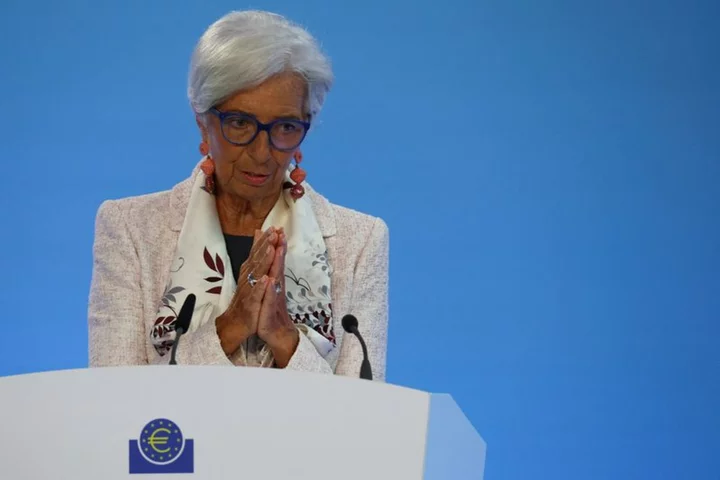
Global central banks begin policy shift as inflation cools
By Howard Schneider, Francesco Canepa and Leika Kihara WASHINGTON/FRANKFURT/TOKYO (Reuters) -Top central banks continued with another round of interest rate
1970-01-01 08:00

Russia says a Ukrainian drone was shot down outside Moscow
Russia’s defense ministry says a Ukrainian drone was shot down early Friday outside Moscow, the third drone strike or attempt on the capital region this month
1970-01-01 08:00
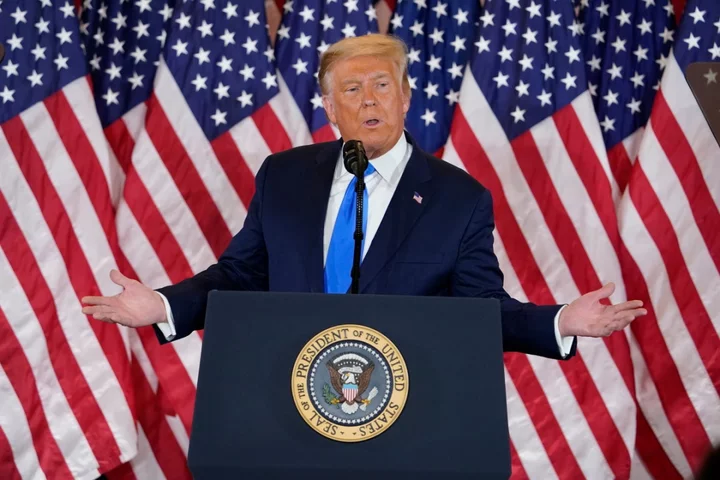
Read Donald Trump’s new superseding indictment in classified documents case in full
Donald Trump was hit with a new set of federal charges on Thursday related to his alleged mishandling of classified documents since leaving the White House in January 2021. Mr Trump and his aide Walt Nauta had already been charged in Justice Department special counsel Jack Smith’s investigation into the retention of government documents at the former president’s Mar-a-Lago home in Palm Beach, Florida. Now, the new superseding indictment brings fresh charges against the two men and also makes a formal allegation against a third man – Mar-a-Lago property manager Carlos De Oliveira. Prosecutors have accused the three men of plotting to deleting security footage from Mar-a-Lago in order to conceal potential evidence of misconduct. The fresh charges come at a time when Mr Smith is also pursuing another probe into Mr Trump over his efforts to overturn the result of the 2020 presidential election and his role in the Capitol riot of 6 January 2021. Here you can read the superseding indictment in the classified documents case in full: Read More Trump news – live: Trump hit with new charges in classified documents case as Mar-a-Lago aide indicted Trump hit with more charges as Mar-a-Lago worker added to documents case Carlos De Oliveira: Who is second Trump aide now charged in Mar-a-Lago secret documents case Is Donald Trump going to prison?
1970-01-01 08:00

Did Jason Aldean actually order 65 burritos and not leave a tip?
Days after Jason Aldean went viral over a song about small town America that many commentators have interpreted as containing lyrics which amount to dog-whistle racism, the singer was mired in fresh controversy. Somewhat appropriately it was over another alleged scandal in a small town, in which a Twitter user claimed he failed to tip in a burrito restaurant in Charleston, West Virginia, having supposedly ordered 65 burritos ten minutes before the joint closed. Now, the internet wants to know if it actually happened. Sign up to our free Indy100 weekly newsletter On July 20, 2023, a user posted: “Remember when @Jason_Aldean came to small town Charleston, WV, ordered 65 burritos from a local joint ten minutes before close and didn't tip anyone? Then his team reached out after the story went viral and the employees got let go? Try that in a small town." A screenshot of the tweet was widely shared on TikTok, Reddit, and other websites, three days after the Country Music Television (CMT) network pulled Aldean's new music video for his song, 'Try That in a Small Town.' Find out more about the racism scandal engulfing the song here. According to fact-checkers at Snopes, the controversy goes back to a 2017 news story by TMZ, which claimed the singer had ordered 60 burritos and a quesadilla at a restaurant called Black Sheep, which totaled around $500. “We found no concrete information on whether the order was placed for takeout and was picked up by one of Aldean's crew members, or if the entire crew sat down at the restaurant. However, the former appeared to likely have been the case, as we have so far found no photographic or video evidence of the crew eating at the restaurant,” reported the fact checkers. The tweet’s claim that the order for Aldean's crew was made "ten minutes before close" wasn’t mentioned in the original story by TMZ. Arep for Aldean said an "appropriate tip" had been left for the order back in 2017, adding: “Jason had absolutely no contact with the restaurant or any of its employees.” Meanwhile it looks like the tweet’s claim that “employees” were fired by Black Sheep because the story went viral is partially true. The original reporting from TMZ mentioned that one employee who was fired, after apparently tweeting about the order for Aldean's crew. The apparent tweets posted by the employee, which are no longer available, appeared in a second report by TMZ. One of them read: “@Jason Aldean can suck my a-- for not tipping Black Sheep, after ordering 60 burritos.” So to sum up: nobody can quite tell if the story is totally true. Aldean may not have been personally involved, but it looks like there was a big old burrito order for him and his crew, and there was definitely some controversy around the tip. We’ll have to leave the rest to your imagination. Have your say in our news democracy. Click the upvote icon at the top of the page to help raise this article through the indy100 rankings.
1970-01-01 08:00

Ajax director confirms interest in Mohammed Kudus & Edson Alvarez
Ajax director Sven Mislintat offers an update on the futures of Mohammed Kudus & Edson Alvarez.
1970-01-01 08:00

AIB makes a pre-tax profit of €987m
Its UK division, which includes its NI business, had a pre-tax profit of £119m, up £53m since 2022.
1970-01-01 08:00

Who won 'Too Hot To Handle' Season 5? Elys bags $100K only to share the spotlight with Dre
Elys claims victory in 'Too Hot To Handle' finale but chooses to share the glory, leaving with 50K as she splits the prize with Dre
1970-01-01 08:00