
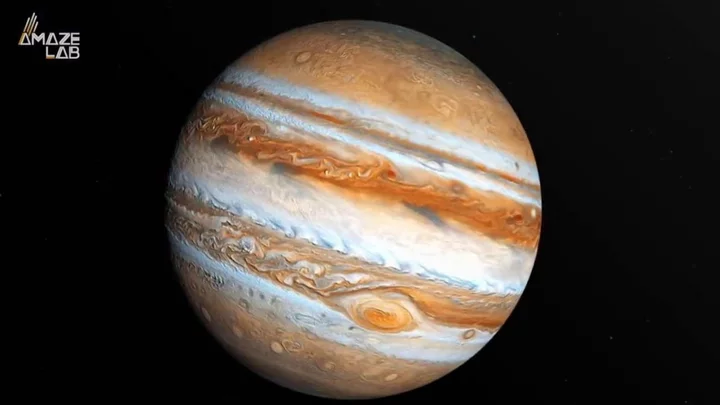
Rare 'ocean' planet found that is twice the size of Earth
A rare planet has been discovered hundreds of light years away, and it could prove key to our understanding of planetary formations out there in the universe. There have been more than 5,300 exoplanets discovered, but few match the description of the newly recorded TOI-733b. Found 245 light-years away, TOI-733b is almost twice the size of Earth and orbits a sun slightly smaller than our Sun. While there are many exoplanets, there are a surprisingly small number which sit between one and a half and two times the radius of the Earth, and it's the size that makes it so interesting to scientists. Sign up to our new free Indy100 weekly newsletter The research was conducted by a team of astronomers led by Iskra Georgieva of Chalmers University of Technology in Sweden. It was accepted for publication in Astronomy & Astrophysics. The team focused on TOI-733b after data on the planet was collected by NASA's telescope TESS. The density of the planet suggests two things – it’s either totally covered in water, or it’s lost its atmosphere altogether. Clues point to the idea of TOI-733b’s atmosphere slowly depleting. That’s due to the proximity of the planet to its star, which it orbits in the space of just 4.9 days. If the atmosphere is being burned away, it means it could soon be transformed into a rock planet. The other possibility points to the planet having lost its hydrogen and helium, while retaining an atmosphere packed with water vapour. "Answering the question of whether TOI-733b has a secondary atmosphere or is an ocean planet boils down to differentiating between a Neptune-like planet that lost its ∼10 per cent of H/He to leave behind a steam atmosphere of heavier volatiles, and one that formed and remained relatively the same throughout its evolution," the research reads. "While being beyond the scope of this paper, finding an answer to this question will have broad implications on our understanding of exoplanets." The team went on to write: "By all accounts TOI-733 b looks to be an interesting planet and holds the potential of being a small but key piece to solving big puzzles in exoplanet science. "With ever increasing in-depth theoretical analyses and the promise of high-precision follow up by present and upcoming facilities, we seem to be well on the way to finding answers to major questions relating to planet formation and evolution." Have your say in our news democracy. Click the upvote icon at the top of the page to help raise this article through the indy100 rankings.
1970-01-01 08:00

Kate Winslet calls on Government to ‘criminalise harmful content’
Kate Winslet has called on the “people in power” to “criminalise harmful content” as she picked up the leading actress gong at the Bafta TV awards. The Oscar-winning actress, 47, starred alongside her daughter Mia Threapleton in I Am Ruth which chronicles the relationship between a mother and child who is dealing with mental health pressures coming from the online world. On Sunday, Winslet told the ceremony: “I Am Ruth was made for parents and their children, for families who feel that they are held hostage by the perils of the online world, for parents who wish they could still communicate with their teenagers, but who no longer can. “And for young people who have become addicted to social media and its darker sides, this does not need to be your life to people in power, and to people who can make change, please, criminalise harmful content. “Please eradicate harmful content, we don’t want it. “We want our children back. “We don’t want to lie awake, terrified, by our children’s mental health and to any young person who might be listening, who feels that they are trapped in an unhealthy world. “Please ask for help. “There is no shame in admitting that you need support. “It will be there just ask for it.” Her comments came as the House of Lords continued its scrutiny of the Online Safety Bill, which aims to tackle illegal and harmful content online. Winslet stars as Ruth, a concerned mother who witnesses her teenage daughter Freya, played by 22-year-old Threapleton, retreating into herself as she becomes more consumed by the pressures of social media in the two-hour programme. It is an instalment of the female-led drama anthology series I Am, created by filmmaker Dominic Savage, which also picked up a Bafta on the night for the programme with Winslet. Each of the films followed the experience of women in particularly raw, thought-provoking and personal moments. Read More Charity boss speaks out over ‘traumatic’ encounter with royal aide Ukraine war’s heaviest fight rages in east - follow live Humans could be controlled by robots, AI firm’s founder warns AI pioneer warns UK is failing to protect against ‘existential threat’ of machines Most deprived areas being left in broadband slow lane, says LGA
1970-01-01 08:00

Apple supplier Foxconn to invest $500 million in India's Telangana state
BENGALURU (Reuters) -Apple Inc supplier Foxconn will invest $500 million to set up manufacturing plants in the southern Indian state
1970-01-01 08:00

Google Launching Tools to Identify Misleading and AI Images
Google is adding two new features to its image search to reduce the spread of misinformation, especially now
1970-01-01 08:00

Ex-ByteDance employee claims China had 'supreme access' to all data
China's Communist Party had "supreme access" to all data held by TikTok's parent company Bytedance, including on servers in the United States, a former employer who is bringing a wrongful termination lawsuit has alleged.
1970-01-01 08:00

75% of Irish data watchdog’s GDPR decisions since 2018 overruled – report
Three quarters of the Irish data watchdog’s GDPR decisions were overruled by European regulators, a report has found. The report indicates that 75% of the Data Protection Commission’s decisions in EU cases over a five-year period were overruled by the European Data Protection Board (EDPB). The EDPB had demanded tougher enforcement action in these cases, the report by the Irish Council for Civil Liberties (ICCL) said, with only one other country in one other case overruled in such a manner. The figures include final decisions from January 2023 that are not yet included in the EDPB register of final decisions, from which the figures are based. If these three cases are not included, the figure is 88% of DPC decisions overruled. The report said that the DPC tends to use its discretion under Irish law to choose “amicable resolution” to conclude 83% of the cross-border complaints it receives, instead of using enforcement measures. The ICCL report claims that Ireland remains “the bottleneck of enforcement” for major cross-border cases in Europe. “When it does eventually do so, other European enforcers then routinely vote by majority to force it to take tougher enforcement action,” it said. As Google, Meta, Apple, TikTok and Microsoft have headquarters in Ireland, the Data Protection Commission is the lead authority investigating data privacy complaints about tech giants in Europe. Some 87% of cross-border GDPR complaints to Ireland’s DPC also involve the same eight companies: Meta, Google, Airbnb, Yahoo!, Twitter, Microsoft, Apple, and Tinder. On EU-wide cases, the ICCL report found that since May 2018 – when GDPR laws came into effect – and late 2022, 64% of the 159 enforcement measures were reprimands, stating that enforcement against tech giants in Europe “remains largely paralysed”. The EDPB register of EU-level decisions shows there were 49 compliance orders issued over four and a half year years. The report called on the European Commissioner for Justice Didier Reynders to “take serious action” to enforce GDPR laws across Europe. Last summer, the Irish Government announced that two additional data protection commissioners would be hired, and that Helen Dixon would be promoted to chairwoman of the DPC – in an attempt to better resource the watchdog in recognition of its growing workload. The DPC has been carrying out a review of its governance structures, staffing arrangements and processes since last summer. Read More Charity boss speaks out over ‘traumatic’ encounter with royal aide Ukraine war’s heaviest fight rages in east - follow live Kate Winslet calls on Government to ‘criminalise harmful content’ Humans could be controlled by robots, AI firm’s founder warns AI pioneer warns UK is failing to protect against ‘existential threat’ of machines
1970-01-01 08:00
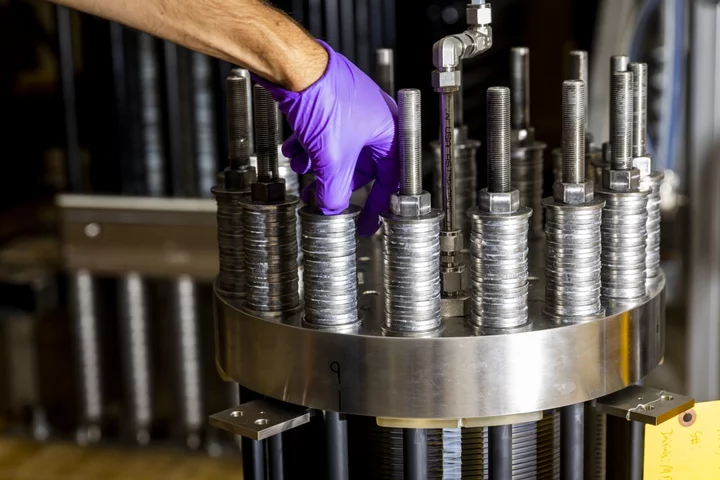
Denmark’s Topsoe Plans $300 Million US Factory to Build Hydrogen Electrolyzers
Denmark’s Topsoe A/S is preparing to spend $300 million on a US hydrogen electrolyzer factory in the latest
1970-01-01 08:00

Credit Suisse Managing Director Says Bank Actively Seeking ESG Debt Deals
A senior investment banker at Credit Suisse AG says his team is actively seeking new deals in a
1970-01-01 08:00
Crypto’s Most Influential Companies Often Follow Their Own Rules — Even After FTX’s Collapse
Before it filed for bankruptcy last November, many of the entities in Sam Bankman-Fried’s colossal FTX empire had
1970-01-01 08:00

7 Dangerous and Deadly Toys From History
The toys on this list include "what were they thinking?" oddities—like a children's laboratory kit that included uranium—but also some seemingly innocuous recreational offerings.
1970-01-01 08:00
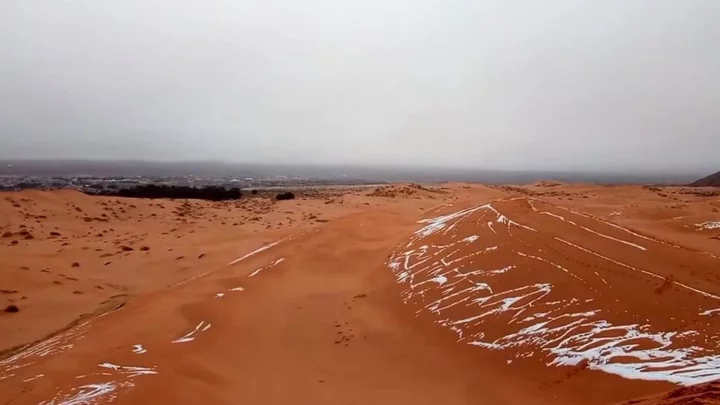
Flooding Sahara desert to create a brand new sea proposed as radical climate change solution
It might sound more like the kind of idle daydream billionaires like Elon Musk would have, but could flooding the Sahara actually be the best way of tackling climate change in the future? The idea of creating a new “sea” in Africa is being discussed, and it’s not the first time that the notion of a great oasis in the Sahara has been discussed among the scientific community. As the ongoing climate crisis continues to worsen, the notion of flooding vast areas of the desert is being returned to once again [via IFL Science]. A new “sea” was first proposed following the study of the Messinian salinity crisis – which saw a dried-out area of the Mediterranean rejuvenated by the Zanclean flood, reconnecting the Mediterranean Sea to the Atlantic Ocean around 5.33 million years ago. Sign up to our free Indy100 weekly newsletter Given how the Mediterranean was transformed by the flood, the idea of flooding the Sahara to achieve similar results has been thrown around in the scientific community as far back as 1877, the Scottish engineer Donald McKenzie suggested flooding the El Djouf basin in Western Africa. The idea is now returning to popularity as the world looks for solutions to the climate crisis. One proposal centres on the Middle East’s Dead Sea and flooding the area using water from the Red Sea to the Dead Sea Depression. A vast sea in Africa could represent a hugely innovative step towards tackling climate change and fostering a new hub of life – but even the people suggesting work such a project acknowledge just how expensive and dangerous it is. Even Y Combinator is a US startup accelerator who has described “desert flooding” as “risky, unproven, even unlikely to work”. Only time will tell whether the notion of a new sea in the Sahara coud ever work, or whether it’ll remain the stuff of dreams. Have your say in our news democracy. Click the upvote icon at the top of the page to help raise this article through the indy100 rankings.
1970-01-01 08:00
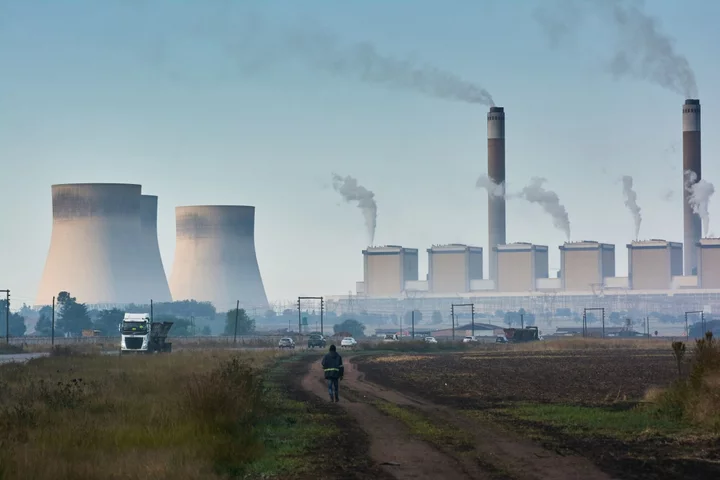
South Africa Beats Climate Goal as Blackouts Slash Emissions
South Africa is ahead of its target for cutting emissions of greenhouse gases. Output of the climate-warming gases
1970-01-01 08:00